


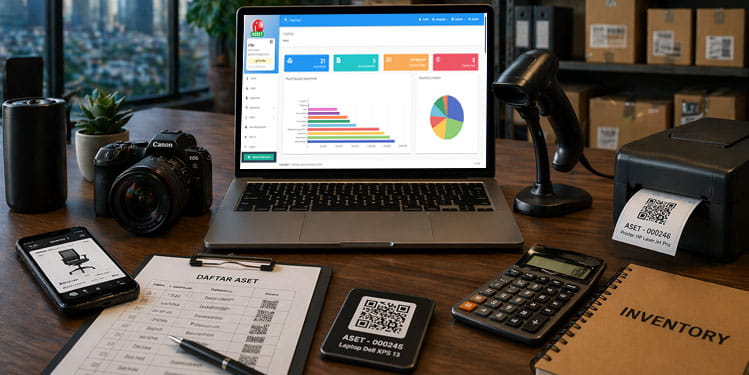
Most businesses fail not because of a lack of customers—but because they don’t know how many assets they have, and how many they’ve lost without realizing it.
Do you know the total value of your business assets today? Where are they located? Who is currently using them? When were they last serviced?
If those questions make you hesitate, you are not alone. Many business owners—from MSMEs to medium-sized companies—still manage assets reactively: only taking action when something is lost, broken, or when a sudden audit occurs.
This article discusses the 7 most common mistakes in business asset management, complete with practical solutions you can implement immediately.
Why is Asset Management Often Ignored?
Asset management is often considered a “later problem” because it doesn’t directly impact sales. In reality, poorly managed assets are silent but consistent financial leaks.
The numbers above are not just statistics—this is money leaking out of your business cash flow every year for no reason.
7 Fatal Mistakes in Business Asset Management
Mistake #1 — No Consistent Recording System
This is the root of almost all asset problems. Some businesses record assets in Excel, some in physical books, and some don’t record them at all. The result? No one knows for sure what the company actually owns.
- Different teams have different versions of the asset list
- Assets go missing or are unaccounted for during stocktakes
- Audit reports are always rushed and inaccurate
Establish a single asset recording system as the single source of truth. Every new asset should be recorded as soon as it is received, complete with photos, serial numbers, purchase dates, and placement locations.

Mistake #2 — Relying on Spreadsheets for Hundreds of Assets
Excel is a great tool—for many things. But not for a growing business’s asset management. When assets reach dozens or hundreds of items, a spreadsheet becomes a ticking time bomb.
- Excel files are easily deleted or corrupted without automatic backups
- Cannot be accessed simultaneously by multiple teams
- No automatic notifications or reminders for maintenance
- Inability to track data change history accurately
- Not integrated with company financial reports
This is where many businesses shift to more structured solutions. Applications like iREAP Asset are specifically designed to replace spreadsheets with a more reliable, integrated system accessible from anywhere—including directly from smartphones in the field.
Mistake #3 — Failure to Physically Label Assets
You might have complete records on your computer, but if the physical assets aren’t labeled, they are useless during field checks. How does your team distinguish between an IT department laptop and a finance laptop if there are no identifiers?
Use QR Code or barcode labels printed from your asset management system. Each asset gets a unique identity that can be scanned directly from a smartphone. iREAP Asset provides a built-in feature to generate and print QR Code labels, allowing the labeling of hundreds of assets to be completed in a single workday.
Mistake #4 — Ignoring Asset Depreciation
Many business owners are shocked to find that a laptop bought for $1,000 four years ago now has a book value of only $200. If depreciation isn’t calculated and recorded, your financial reports become misleading—and business decisions based on that data risk going the wrong way.
“An asset without recorded depreciation is like money that appears to exist on paper but actually has no value.”
Calculate depreciation consistently using appropriate methods—whether straight-line, declining balance, or units of production. Ideally, this process should run automatically without needing manual monthly calculations.
Mistake #5 — No Asset Lending SOP
Laptops taken home by employees, operational vehicles used without permission, projectors “borrowed for a moment” but never returned. This isn’t fiction—it happens in almost every office without clear asset lending procedures.
- Create a lending form that records who borrowed what, when, and for how long
- Define who is authorized to approve the lending of high-value assets
- Establish clear consequences if assets are not returned on time or are returned damaged
- Use a digital system so lending history is recorded and can be audited at any time
Mistake #6 — Skipping Routine Maintenance Schedules
Operational vehicles not serviced on time will break down on the road. Uncalibrated production machinery produces defective output. Unmaintained office ACs inflate electricity bills. All of this leads to costs far greater than the routine maintenance costs that were ignored.
Record the service schedule for every asset, then ensure there is a system to remind you—or the responsible staff—before the schedule is missed. Automating these reminders is very easy with modern asset management applications.
Mistake #7 — Manual Stocktakes Only Once a Year
Annual manual stocktakes are a nightmare: they take 3–5 workdays, the results are often inaccurate, and the team involved gets exhausted. Many businesses end up ignoring stocktake findings because the process is too exhausting to follow up on.
In fact, with the right technology, stocktakes can be done more frequently—even quarterly—in much less time. With the mass QR Code scanning feature available in iREAP Asset, checking hundreds of items can be completed in just a few hours using a standard smartphone.
Checklist: How Healthy is Your Business Asset Management?
Use this checklist to evaluate the current state of asset management in your business:
- All assets are recorded in a centralized system that is always updated
- Every physical asset has a clear identification label
- Depreciation values are calculated consistently every accounting period
- There is a clear SOP for lending and returning assets
- Maintenance schedules for all assets are documented with a reminder system
- Stocktakes are performed at least twice a year with reliable data
- Asset condition reports can be generated at any time without manual compilation
If any points are not yet met, those are your top priorities for improvement. It doesn’t have to be perfect all at once—start with one consistent system and build from there.
The First Step You Can Take Today
Good asset management isn’t about having the most expensive system. It’s about consistency and discipline in recording. Start with something simple: make a list of all the assets you own today, take photos of each item, and record their condition and location.
If your business has passed that stage and needs a more structured system, consider a digital asset management platform that can automate most of the processes discussed in this article. iREAP Asset is one option designed specifically for business needs—from asset recording and QR Code labeling to automatic depreciation reports, all available in one platform. Visit the website to check more details: https://asset.ireappos.com/
Because ultimately, a business that grows sustainably is one that knows exactly what it owns—and takes good care of it.
Ready to Organize Your Business Assets?
Learn more about how iREAP Asset can help your business manage all physical assets in one easy-to-use platform.