



In the daily operations of distribution or manufacturing companies in Indonesia, it is common to encounter situations where the sales department aggressively pursues targets. Goods must be dispatched immediately, delivery documents must be issued without delay, yet on the other hand, the warehouse administration or the purchasing department has not had the opportunity to record the receipt of goods into the system.
The result? The emergence of the stock deficit phenomenon, commonly referred to as negative inventory.
For many business owners or warehouse managers who still rely on manual records or simple inventory applications, negative stock is often regarded as “a normal occurrence” that can simply be corrected at the end of the month.
However, within an integrated ERP (Enterprise Resource Planning) ecosystem, negative inventory is a ticking time bomb capable of undermining the validity of financial reports, distorting the calculation of Cost of Goods Sold (COGS), and eroding management’s control over the company’s physical assets.
This article explores in depth why negative inventory occurs, its implications for a company’s financial health, and how SAP Business One provides control mechanisms to ensure that system data always remains aligned with the physical realities of the warehouse.
What Is Negative Inventory in SAP Business One?
In its simplest definition, negative inventory is a condition in which the quantity of an item recorded in the system falls below zero. This situation arises when the system permits an outbound transaction (such as a sale or production consumption) that exceeds the current recorded stock balance.
Within the context of SAP Business One, inventory is far more than a mere numerical value within the warehouse module. Every movement of goods is automatically linked to the Finance module through accounting journal entries.
When inventory becomes negative, the system encounters significant difficulty in determining accurate inventory valuation, particularly if the company employs valuation methods such as Moving Average or FIFO.
Why Does Negative Inventory Occur in Companies?

Based on our experience implementing ERP systems across numerous companies in Indonesia, negative inventory rarely results from system errors. Instead, it is almost always caused by a lack of synchronization between physical business processes and administrative data entry.
Below are several common causes frequently encountered:
- Sales Processes Precede Receiving Administration: The sales team has already issued a delivery document (Delivery) and the goods have been shipped to the customer, yet the warehouse team has not recorded the Goods Receipt PO (GRPO) for items newly arrived from the supplier.
- Delayed Purchasing Data Entry: A considerable time lag exists between the physical arrival of goods at the warehouse and the arrival of the corresponding documents at the administrator’s desk for system input.
- Errors in Manual Warehouse Recording: Without strict system validation, warehouse staff may inadvertently pick the wrong item type (incorrect item code). Physically the item may exist, but within the system the stock for that particular code is recorded as zero.
- Weak Interdepartmental Integration: Insufficient coordination between the Purchasing, Warehouse, and Sales teams. The Sales team may be unaware that the item they are selling has not yet been officially “received” into the system.
- Discrepancies Between System and Physical Stock: Damaged or rejected items that have not yet been processed through Inventory Audit or Stock Take. Consequently, the system assumes the items remain available and permits sales transactions, even though the physical goods are no longer saleable.
The Impact of Negative Inventory on Operations and Finance
Many managers ask, “What is the issue if stock becomes negative briefly? It can simply be corrected once the receipt is entered.”
From both accounting and managerial perspectives, the consequences can be severe.
1. Distortion of Inventory Value and COGS
When inventory becomes negative, SAP Business One struggles to determine the precise Cost of Goods Sold (COGS) at the moment goods are issued.
If COGS is inaccurate, the company’s Profit and Loss statement becomes unreliable. You may believe the business is generating strong profits, while in reality your margins are quietly eroded due to distorted inventory valuation.
2. Disruption of Financial Statements
Every Delivery transaction in SAP B1 debits the COGS account and credits the Inventory account. If inventory becomes negative, the inventory balance within the Balance Sheet may appear abnormal—an issue that will inevitably raise red flags during internal or external audits.
3. Faulty Purchasing Decisions
Purchasing managers depend heavily on inventory data when placing orders. If negative stock goes unnoticed or is tolerated, the Inventory Status report becomes misleading. This may result in overstock of items that are actually abundant, or prolonged out-of-stock conditions for items that are urgently required.
4. Cash Flow Disruptions
Inaccurate inventory data forces purchasing decisions to become reactive rather than strategic. Companies frequently resort to emergency purchases at higher prices to cover stock shortages, ultimately destabilizing cash flow.
How SAP Business One Controls Negative Inventory
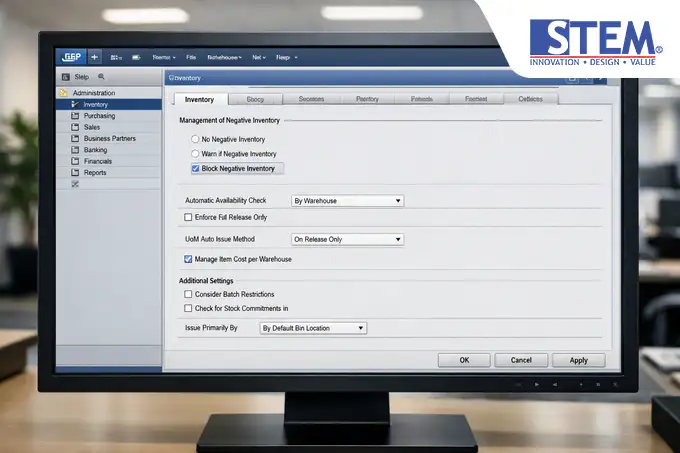
As a world-class ERP solution, SAP Business One is designed with robust internal controls to prevent negative inventory from occurring.
“Block Negative Inventory” Setting
SAP Business One provides a System Setup feature that allows companies to decide whether negative inventory should be permitted or prohibited.
- Block Negative Inventory: When this feature is activated, the system automatically rejects outbound inventory transactions (such as Delivery or Goods Issue) if the available stock balance is insufficient. An error message will appear, compelling the user to ensure that the goods receipt has been properly recorded beforehand.
Real-Time Validation in Document Flow
The system ensures that document processes follow a logical and integrated sequence:
- Sales Flow: Sales Order → Delivery → AR Invoice. The system verifies stock availability at the Delivery stage. Without sufficient inventory in the specified warehouse, the Delivery document cannot be added.
- Procurement Flow: Purchase Request → Purchase Order → GRPO → AP Invoice. By ensuring that GRPO is entered promptly, inventory balances update in real time, allowing the Sales team to proceed with shipment without delay.
Inventory Control Mechanisms in SAP Business One
Beyond blocking negative stock, SAP B1 provides numerous control instruments to ensure optimal inventory management:
- Real-Time Stock Visibility: Every department (Sales, Purchasing, Finance) views the same inventory data in real time. The assumption that “stock should still be available” no longer exists.
- Warehouse Management: Multi-warehouse stock configuration enables more precise control. For instance, negative stock may be strictly prohibited in the main warehouse while allowing limited flexibility within a returns warehouse if necessary.
- Batch & Serial Number Tracking: For companies requiring expiration tracking or serial identification, SAP B1 ensures that outgoing goods correspond to valid batch or serial numbers registered in the system.
- Automatic Inventory Valuation & Posting: Every inbound and outbound transaction automatically generates journal entries in the General Ledger (GL) based on the chosen valuation method (Moving Average, FIFO, or Standard Cost).
- Document Audit Trail: Each inventory movement can be traced through the Relationship Map. If suspicious stock activity occurs, management can immediately identify the originating document, the responsible user, and the transaction time.
- Approval & Authorization: Potentially exceptional transactions can be governed through Approval Templates. For example, goods issued for sample purposes may still proceed despite low stock levels, but only with authorization from the Inventory Manager.
The Benefits of Avoiding Negative Inventory

By implementing disciplined SAP B1 inventory controls, companies gain significant long-term advantages:
- Accurate Financial Reporting: Profit and loss statements and balance sheet asset values consistently reflect actual conditions without extensive manual adjustments at period end.
- Precise Purchasing Planning: With the MRP (Material Requirement Planning) feature, SAP B1 can recommend optimal purchasing times based on real stock levels and defined minimum inventory thresholds.
- Improved Customer Trust: The Sales team commits to delivery schedules based on reliable stock data, minimizing the risk of order cancellations caused by unexpected stock shortages.
- Operational Efficiency: Time previously spent reconciling stock discrepancies between warehouse and administrative teams can be significantly reduced.
Case Study: Transformation of a Distributor in Jakarta
Before implementing ERP, a vehicle spare parts distributor in Jakarta regularly experienced inventory discrepancies amounting to hundreds of millions of rupiah annually.
The principal cause was a long-standing practice of “ship first, record later,” which consistently drove system stock into negative territory. As a consequence, the Finance team was forced to perform risky manual adjustments each month, increasing exposure to potential fraud.
After implementing SAP Business One through Sterling Tulus Cemerlang (STEM), the company established strict operational policies:
- The system blocks negative inventory.
- Document flow must be strictly followed: no shipment may occur without a Delivery document recorded in the system.
- Warehouse Integration: warehouse staff were equipped with tools enabling GRPO input immediately after goods were unloaded from supplier trucks.
The result?
Within the first six months, inventory discrepancies declined by 95%. Management now possesses far more accurate product margin reports because COGS is no longer distorted by negative inventory.
Which Companies Must Avoid Negative Inventory?
Although all businesses should strive to prevent negative stock, the following industries face particularly high urgency:
- Distributors & Trading Companies: Where transaction volumes are high and inventory turnover is extremely rapid.
- Manufacturing: Negative stock in raw materials can halt production planning (Production Order) and disrupt the calculation of manufacturing costs.
- Retail with Multiple Branches: Synchronization of stock across branches is critical to prevent double-selling of the same item.
Conclusion: The Importance of Integrated Inventory Control
Negative inventory is not merely a technical anomaly within an application; it is a reflection of undisciplined business processes. Preventing stock deficits is a fundamental step toward professional and transparent corporate management.
With SAP Business One, companies gain far more than a tool for recording inventory—they acquire a comprehensive control system that integrates every department.
The seamless integration of procurement, storage, and sales processes ensures that every unit of currency invested in inventory can be accounted for accurately within financial statements.
Discuss your SAP Business One requirements with our team of experts. We are ready to help you map the most effective business processes to achieve operational efficiency and optimal data accuracy.
Contact the Sterling Team for a Consultation on the Right Inventory Control Implementation