



Asset depreciation methods in SAP Business One represent a system configuration framework that governs how the acquisition value of fixed assets is systematically depreciated throughout their useful life. Its principal function is to calculate periodic depreciation expenses, continuously update the Net Book Value, and automatically generate corresponding journal adjustments within the General Ledger—eliminating the risks inherent in error-prone manual intervention.
In Indonesia, the administration of Fixed Assets demands exceptional precision due to the coexistence of two mandatory reporting standards: Financial Accounting Standards (SAK/PSAK) for commercial reporting and Income Tax Regulations (UU PPh) for fiscal reporting. In the absence of a reliable ERP system, reconciling these dual requirements frequently results in computational discrepancies, complex reconciliations, and heightened audit exposure.
What Are Asset Depreciation Methods in SAP Business One?
Within SAP B1 architecture, depreciation methods do not function independently. They are configured within the Fixed Assets sub-module through the integration of three foundational components:
- Asset Class: Asset categorization that determines the associated General Ledger (GL) accounts and default depreciation schemes.
- Depreciation Area: Distinct reporting environments. In Indonesia, organizations may establish one area for Commercial Reporting (PSAK) and another for Fiscal Reporting (Tax) under a single asset master number.
- Depreciation Type: The specific mathematical formula that governs depreciation calculations.
Why Are Depreciation Methods Critical in Fixed Asset Management?
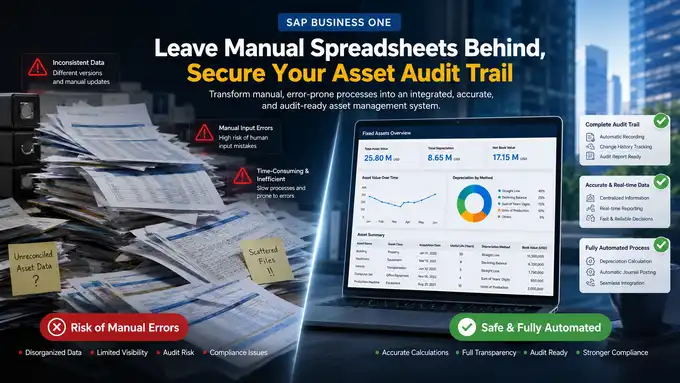
Many medium-sized enterprises continue to face a familiar predicament: asset depreciation is calculated through isolated spreadsheets, then manually entered at month-end via Journal Entries.
Challenges and Risks of Manual Accounting Processes
- Human Error: Miscalculated remaining useful life assumptions or corrupted spreadsheet formulas.
- Data Disparity: Asset values within physical inventory reports become inconsistent with balance sheet account balances.
- Weak Audit Trails: Auditors encounter difficulty tracing depreciation figures due to the absence of direct linkage between asset master records and journal entries.
Through the standardization offered by SAP Business One Fixed Assets, every capitalized asset becomes system-governed in terms of depreciation methodology and useful life allocation. Mid-cycle modifications require designated authorization through SAP Business One approval processes, where enabled. This establishes stringent internal controls, strengthens adherence to corporate accounting policies, and dramatically shortens month-end closing activities from days to mere minutes.
Types of Depreciation Methods in SAP Business One
SAP Business One offers substantial flexibility by supporting a wide array of globally and locally recognized depreciation methods. The following summarizes its framework:
Structured Knowledge Block: SAP B1 Depreciation Method Matrix
| DEPRECIATION METHOD | SYSTEM MECHANISM | BEST SUITED FOR | IMPACT ON FINANCIAL STATEMENTS |
|---|---|---|---|
| Straight Line | Distributes acquisition cost, net of salvage value, evenly across the asset’s useful life. Monthly calculations remain constant. | Buildings, office furniture, facilities, and work equipment. | Produces stable depreciation expenses across reporting periods; book value declines linearly. |
| Declining Balance | Applies a fixed percentage rate to the current Net Book Value. Depreciation expenses are front-loaded and gradually decrease over time. | Manufacturing machinery, operational vehicles, and IT infrastructure. | Generates higher expenses during initial years, preserving profitability when maintenance costs rise in later periods. |
| Multi-Level | Allows useful life segmentation into multiple phases with differing depreciation rates. | Assets exhibiting non-uniform utility deterioration patterns. | Enables expense recognition aligned with actual productivity curves. |
| Manual Depreciation | The system does not perform automatic calculations; users manually input depreciation amounts for designated periods. | Assets depreciated under ad hoc policies or exceptional circumstances. | Expense fluctuations become highly dependent on accountant intervention. |
| Special Depreciation | Additional depreciation beyond standard calculations, commonly used for tax incentives or accelerated amortization. | Industry-specific supporting assets benefiting from government acceleration schemes. | Rapidly reduces taxable income during early periods, enhancing tax-related cash flow efficiency. |
How Does SAP Business One Calculate Asset Depreciation?
The system calculates depreciation values based on parameters defined within Asset Master Data SAP Business One. The calculation framework is driven by three essential variables:
- Acquisition and Production Costs (APC): Total initial acquisition value.
- Useful Life: The asset lifespan expressed in months or years.
- Salvage Value: Residual value at the conclusion of the asset’s useful life, where applicable.
Mathematically, under the Straight Line methodology:
Monthly Depreciation = (APC – Salvage Value) / Total Useful Life (Months)
If additional asset investments occur through Subsequent Capitalization, SAP B1 automatically recalculates the remaining book value and redistributes it across the residual useful life without compromising prior journal history.
How Does the Asset Depreciation Process Flow in SAP Business One?
The fixed asset lifecycle within SAP Business One follows an integrated and methodical process:
[Asset Master Data] ➔ [Capitalization (AP Invoice/Form)] ➔ [Depreciation Type Assignment]
│
[Financial Reports] ◄── [Automatic Journal Entry] ◄── [Monthly Depreciation Run]
1. Asset Master Data Creation
The process begins with asset registration within SAP Business One Asset Master Data. Here, assets are designated as either Virtual Assets or Fixed Assets, followed by assignment of Asset Class, Depreciation Area, and Depreciation Type.
2. Capitalization
Assets become financially activated through Capitalization documents or directly via A/P Invoices when purchased from vendors. These transactions create debit entries to Fixed Asset accounts and credit entries to Vendor Liabilities or Asset Clearing Accounts.
3. Depreciation Type Assignment
The system automatically determines depreciation commencement based on the Asset Value Date. If capitalization occurs on May 15, depreciation may begin fully within May or commence in June according to the organization’s Pro-Rata Convention policy.
4. Depreciation Run Execution
At month-end, finance teams execute SAP Business One depreciation runs via Financials > Fixed Assets > Depreciation Run. The process initially functions in preview mode, allowing users to review estimated depreciation before posting.
5. Automatic Journal Entries
Upon execution, SAP Business One generates consolidated Journal Entries that debit Depreciation Expense accounts and credit Accumulated Depreciation accounts according to each respective Asset Class.
6. Financial Reporting
Updated asset book values immediately reflect actual conditions within the Balance Sheet, while depreciation expenses appear within the Profit & Loss Statement. Users may also generate Asset History Sheet reports for audit requirements.
Common Challenges in Depreciation Configuration
Based on ERP implementation experience, several operational issues frequently emerge:
Issue 1: Incorrect Depreciation Start Date
- Cause: Improper configuration of the Asset Value Date during capitalization.
- SAP B1 Solution: Configure Depreciation Start Date using standardized rules such as First Day of Current Period or First Day of Next Period.
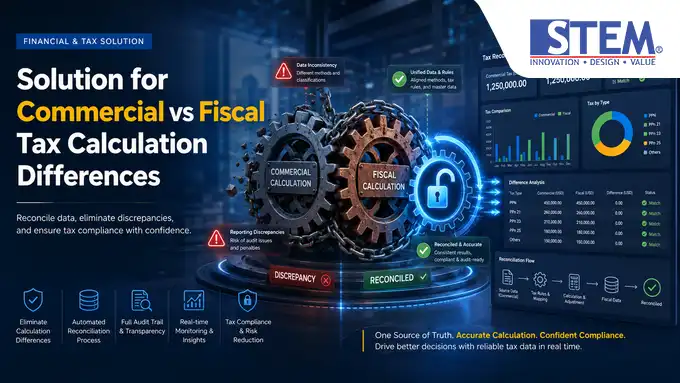
Issue 2: Fiscal vs Commercial Reporting Discrepancies
- Cause: Utilizing a single Depreciation Area for differing reporting frameworks with distinct tax treatment regulations.
- SAP B1 Solution: Establish separate depreciation areas—one configured as Posting to G/L for commercial purposes and another as Derived/Additional Area for fiscal reconciliation.
Impact on Financial Reporting and Internal Control
Consistent implementation of asset depreciation methods in SAP Business One profoundly enhances the integrity of financial information:
- Book Value Accuracy: Ensures assets reported on balance sheets are neither overstated nor understated.
- Comprehensive Automation: Eliminates labor-intensive manual reversing entries and year-end corrections.
- Audit Compliance: Every depreciation figure remains traceable to its originating Asset Master Data, complete with execution timestamps and user activity records.
Explore additional SAP Business One insights to elevate Fixed Asset management and strengthen enterprise-wide business process control through an integrated and highly accurate system.